Overview
Origins and Formation
The Navajo people, who call themselves Diné (“The People”), are one of the largest Native American nations in the United States. Today, they mainly live across:
- Arizona
- New Mexico
- Utah
within the territory known as the Navajo Nation.
Northern Origins
Linguistic and archaeological studies suggest that the Navajo originated from northern Athabaskan-speaking peoples from areas around:
- Western Canada
- Alaska
They are believed to have migrated southward between approximately 1000 CE and 1500 CE, eventually settling in the American Southwest.
Relationship with the Apache
The Navajo are closely related to other Athabaskan-speaking peoples, including:
- Apache peoples
- Chipewyan peoples
- Gwich’in peoples
Among them, the Navajo and Apache share especially close linguistic and cultural ties.
Navajo Nation Flag (established in 1968)
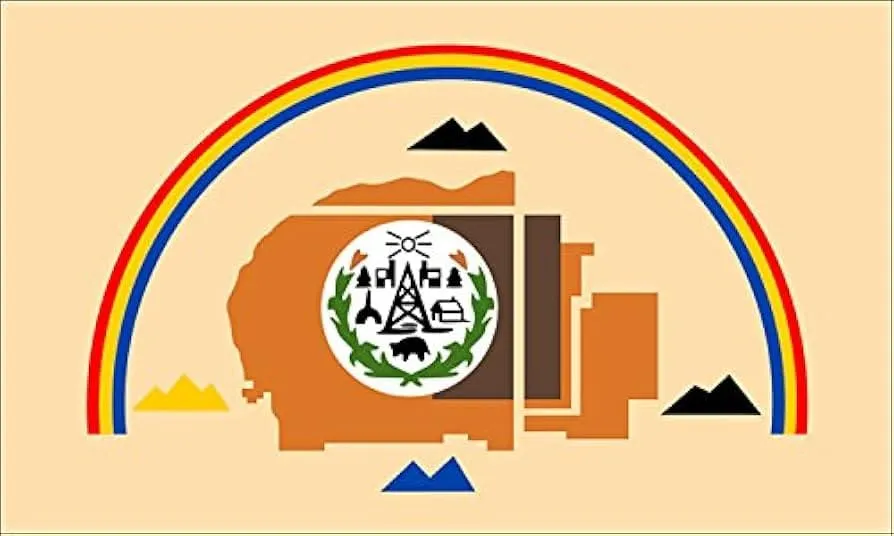
- Triangular design representing the four sacred mountains
- Sand-painting-style central symbols including cattle, oil rigs, and crops
- Outline of the Navajo Nation territory on a U.S. map
Other Sacred Symbols
Rainbow, eagle feathers, and the Hogan (traditional dwelling)
History
Spanish Colonial Period (16th–18th Century)
Spanish explorers and settlers entered the American Southwest during the 16th century, leading to contact with the Navajo.
During this period, the Navajo adopted:
- Horses
- Sheep
- New farming techniques
Sheep herding became especially important and later formed the foundation of Navajo weaving culture.
Development of Pastoral Culture
The Navajo developed a society based on:
- Sheep herding
- Farming
- Trade
They also became known for:
- Silverwork
- Navajo rugs and weaving
which later gained international recognition.
Conflict with the United States
In the 19th century, conflicts intensified as the United States expanded westward.
During the 1860s, the U.S. military launched major campaigns against the Navajo people.
The Long Walk
In 1864, thousands of Navajo people were forcibly removed from their homeland and marched to:
Bosque Redondo, New Mexico
This forced relocation became known as:
The Long Walk
Many people died from starvation, disease, and exhaustion.
It remains one of the most tragic and important events in Navajo history.
Return and Self-Government
In 1868, the Navajo signed a treaty with the United States government and were allowed to return to part of their homeland.
Over time, this led to the establishment of:
- Navajo reservations
- Navajo self-government
Language
Language: Navajo Language
Language Family
Athabaskan branch (Na-Dené family)
Features
・Strong syllabic structure and rich affixation (especially in verbs)
・Presence of glottalized consonants and nasal vowels
・Polysynthetic verb structure incorporating subject, object, tense, etc.
Current Status
Facing decline among younger generations, but revitalization efforts are ongoing through education and media
Common Greetings and Expressions (in Navajo)
| English | Navajo Language (Hunan Dialect Example) | Pronunciation |
| Hello | Yáʼátʼééh | Yaa-aht-teh |
|---|---|---|
| How are you? | Nizhónígo shí? | Nee-zho-nee-go shí? |
| Thank you | Ahéheeʼ | Ah-heh-heh |
| Good night | Yáʼátʼééh hiiłchiʼígíí | Yaa-aht-teh heehl-chʼee-ee-gee |
| Beautiful/Harmony | Hózhǫ́ | Hoh-zho |
Notes
Ntxoov zoo can mean both "hello" and "how are you?"
Regional variations are common in Miao language expressions.
Navajo Code Talkers
During World War II, Navajo speakers served as:
The U.S. military used Navajo as a coded communication system because it was extremely difficult for outsiders to understand.
The code was never broken by Japanese forces and became one of the most famous military code systems in history.
This remains a major source of pride within Navajo communities.
Writing Systems
- Script Used: Latin alphabet (English letters with added diacritics)
- Examples::"Yáʼátʼééh" (Hello), "Hózhǫ́" (Harmony, beauty, peace)
Distinctive Features:
・Apostrophes (ʼ) indicate glottal stops
・Accents (´) and nasal letters (ł, ą, etc.) are used
Language Origins and Historical Background
Navajo is part of the Athabaskan language group, originally from Alaska and western Canada
Migrated southward after 1000 CE, settling in the American Southwest
Adopted agriculture from the Pueblo peoples while maintaining warrior and semi-nomadic traditions
Cultural Characteristics
The Name “Diné”
The Navajo traditionally refer to themselves as:
Diné
mening:
“The People”
The word “Navajo” comes from a Spanish adaptation of earlier Indigenous terms.
Matrilineal Society
Traditionally, Navajo society is:
- Matrilineal
- Clan-based
Children belong to the mother’s clan, and family identity and property are often passed through the maternal line.
Hogan
Traditional Navajo homes are called:
Hogan
These structures are usually made of wood and earth, and their entrances traditionally face east.
Weaving Traditions
The Navajo are especially famous for:
- Rugs
- Blankets
- Weaving arts
Their textile traditions are deeply connected to sheep herding culture.
Silver and Turquoise Jewelry
From the 19th century onward, Navajo artisans became widely known for:
- Silver jewelry
- Turquoise craftsmanship
Navajo jewelry remains internationally popular today.
Religion and Spiritual Philosophy
Traditional Navajo spirituality emphasizes:
- Harmony with nature
- Ceremonies
- Healing rituals
- Sandpaintings
Hózhó
One of the most important Navajo concepts is:
This philosophy represents:
- Harmony
- Beauty
- Balance
- Peace
and forms the foundation of Navajo worldview and ethics.
Region
Continent: Oceania
Region:Primarily in southern China (Guizhou, Hunan, Yunnan), and spread to Vietnam, Laos, and Thailand.
Access Guide
The currency of the Navajo people is the United States Dollar (USD, $).
The currency shown here is the official currency (US Dollar) of the United States, where the Navajo people mainly live. Different currencies may be used in other countries.
Navajo Nation
| Departure City | Direct/Transit | Arrival Airport | Flight Time (approx.) | Reference Fare (one-way/round-trip, Economy) |
| Los Angeles | Los Angeles→Phoenix→car | Phoenix | 1.5h + 4h drive | US$100–US$300 |
|---|---|---|---|---|
| New York | New York→Phoenix→car | Phoenix | 5.5h + 4h drive | US$200–US$400 |
| London | London→Phoenix→car | Phoenix | 11h + 4h drive | £500–£1,200 |
| Tokyo | Tokyo→Los Angeles→Phoenix→car | Phoenix Sky Harbor | 14–16h + 4h drive | ¥90,000–¥180,000 |
| Sydney | ydney→Los Angeles→Phoenix→car | Phoenix | 17–19h + 4h drive | A$900–A$1,600 |
| Hong Kong | Hong Kong→Los Angeles→Phoenix→car | Phoenix | 17h + 4h drive | HK$5,000–HK$9,000 |
| Shanghai | Singapore→Los Angeles→Phoenix→car | Phoenix | 18h + 4h drive | S$1,100–S$2,200 |
Modern Navajo Society
Navajo Nation
Today, the Navajo Nation is:
- The largest Native American territory in the United States
- More than 70,000 square kilometers in size
It has its own
- Government
- Courts
- Police system
Contemporary Challenges
Modern Navajo communities face challenges including:
- Poverty
- Water shortages
- Healthcare inequality
- Youth unemployment
- Language loss
The decline of Navajo language use among younger generations is considered a major concern.
Cultural Revitalization
In recent years, efforts to preserve and revitalize Navajo culture have expanded through:
- Navajo language education
- Traditional crafts
- Film and media
- Music
- Social media activism
Traditional Games of the Navajo People
1.Archery Practice
Aiming games with ritual importance and warrior training elements
2.Hogan Building Play
Children construct miniature hogans from mud and wood
3.Shoe Tossing & Stone Throwing
Competitions based on distance and foot skill
4.Navajo Checkers (Tsiiʼł)
A traditional strategy game using boards and stones
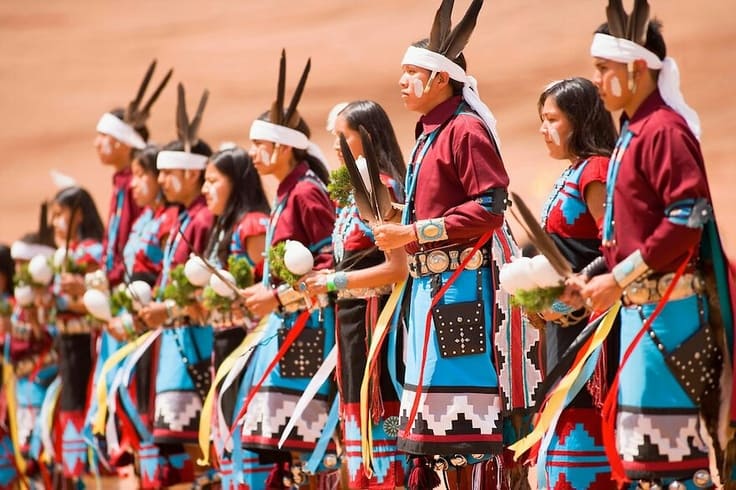
5.Dance & Chant Games
Group activities involving rhythm, movement, and singing
Introduction video
Notes
The Navajo played a crucial role in WWII as Code Talkers using their language for secure communications
Cultural and linguistic revitalization continues through institutions like Diné College